

Mediation in Multicultural Settings
This article is adapted from the author’s Keynote Address at the joint workshop of the New York Bar Association and the New York Chapter of the Association of Nigerian Lawyers, USA, held at the Benjamin N. Cardozo School of Law, New York, on March 29, 2011.
During the Reagan administration, a Chinese leader was quoted as telling the US President and arrowhead of free market capitalism that it was daylight in New York at midnight in Beijing. What the Chinese leader meant was that President Reagan’s view that the American social and economic philosophies could be exported to China was not practicable because the two nations had different cultural traditions and experiences. Culture influences the worldview of a people, including their perceptions of conflict interactions, and how disputes may be resolved. In a world of rapidly shrinking frontiers and advances of communication technology, mediators tend to overlook cultural peculiarities of the disputing parties and assume a one-size-fits-all mindset. Effective mediation or neutral third party intervention in conflict across cultural boundaries demands adequate knowledge of the cultural context of the conflict as well as the basic human needs of the disputants that constitute the main drivers of conflict. This paper will explore the basic nature of the mediation process as an effective alternative dispute resolution method, and suggest options for mediators working in cross-cultural environments to achieve the primary goals of mediation.
Mediation is a non-adversarial method of conflict resolution designed to facilitate communication between the parties to a conflict. According to Zartman (1996), “Mediation is best thought of as a mode of negotiation in which a third party helps parties find a solution which they cannot find by themselves” (p. 446). Steve Slate of the Institute for Mediation and Conflict Resolution defined mediation as “a private, usually voluntary, discussion and consensual decision-making process in which one or more impartial persons – the mediator(s) – assist people, organizations and communities in conflict to work toward a variety of goals.” Christopher Moore (2003) describes mediation as “the intervention in a negotiation or a conflict of an acceptable third party who has limited power or no authoritative decision-making power, who assists the involved parties to voluntarily reach a mutually acceptable settlement of the issues in dispute” (p.15). Doherty (2008) offers a working definition of mediation as a “structured process whereby an impartial mediator facilitates communication between those in dispute in order for them to understand each other better and for them to come up with mutually acceptable solutions that will improve the working relationship in the future” (p.7). What emerges from the above definitions are the basic principles of mediation that distinguish the process from other methods of conflict resolution such as negotiation, arbitration and adjudication.
It is generally believed that conflict is an inevitable aspect of human experience. People conflict as individuals and as groups for a variety of reasons ranging from incompatible goals, values, interests. And when parties fail to resolve their differences on their own, disputes tend to escalate to conflict. In such circumstances, several options are available to the conflicting parties. They include avoidance, negotiation, mediation, arbitration, and litigation. Parties to a conflict may either choose to avoid the conflict or deal with it. Conflict avoidance may be a viable conflict resolution strategy if either of the parties believes that the interest at stake is not sufficient to justify the time and energy involved in pursuing the formal legal options. On the other hand, the conflicting parties may decide to negotiate a settlement. When negotiation fails, they have either to take the legal course or the mediation path. The major difference between the judicial or adjudicative path such as arbitration and litigation, and mediation lies in the degree of ownership and control that the disputants may have over the outcome of the process. This essay will focus on the mediation alternative.
Mediation is used to resolve a wide range of conflicts including family, community, commercial, labor, environmental, workplace disputes and international political conflicts. The concept of mediation developed in the United States in the 1950s and 1960s at the height of the Cold War when it became evident that the then super powers possessed sufficient capability to destroy life on Earth. The practice of mediation has grown in popularity since then, especially in such countries as the United States, the United Kingdom, Australia and India for its advantage over the other methods of conflict resolution. It has been estimated that the success rate of mediation in settling disputes in India is around 60% and about 90% in the United States (Negi, 2007).
The reasons for the rapid growth of mediation as a mechanism for the settlement of disputes, both local and international derive from the following considerations: (a) Mediation is voluntary and the parties to a dispute retain control both of the process and outcome of the mediation; (b) the rate of compliance with agreements reached in mediation is greater than those reached through the legal process; (c) mediation seeks to restore relationships rather than break them; (d) mediation is faster than the tortuous and expensive legal process, and, (e) mediation is less expensive than litigation.
Conflict has a cultural context. Although individuals and groups may conflict for the same reasons, their perceptions of the conflict situation vary from one culture to the other. Every culture has established structures for the resolution of conflict, from the sophisticated to the less complex societies. William Ury’s study of the Bushmen of southern Africa (1995) revealed a complex system of conflict management comparable to, or perhaps superior to, the practice in the more advanced societies. Among the Bushmen of the Kalahari desert, conflict resolution is a communal affair and every member of the community is involved in the peace process. This sense of communal participation enhances compliance with group values and beliefs and the overall integrity and survival of the community. Some understanding of culture is therefore important when dealing with the issue of mediation in cross-cultural environments.
Culture has as many definitions as there are individuals who have interest in the subject. Malin Aquilon (2006) states that there are in fact as many as 400 definitions of culture! Bernard Mayer (2000) describes culture as the “enduring norms, values, customs and behavioral patterns common to a particular group of people”. For the purpose of this essay, it will suffice to understand culture as a system of learned behavior, the traditions of a people that is transmitted from one generation to the next, which incorporates the group’s view about conflict and its management. Culture embodies the totality of the way of life of a people, including their peculiar perception of conflict and system of conflict resolution. It goes without saying that any society that lacks the mechanism for conflict resolution is unlikely to survive for a long time.
While it is possible to identify specific cultural characteristics common to a group or ethnic community, it is also important to remember that there are exceptions or subcultures within every group. These are individuals and groups whose behaviors differ significantly from the dominant cultural norms and values.
We sometimes think of culture in terms of ethnic or national cultures. But there are also organizational cultures, professional cultures and corporate cultures as well as family cultures. Religious groups and ethnic nationalities represent cultural persuasions that are shared by their members. These groups embody the vision, values and principles of their members. From this perspective, every human being is part of a complex set of cultural architecture that may be a combination of family, ethnic, regional, national, educational and, or organizational experiences. It is therefore dangerous to seek to determine the behavior of an individual or group of individuals on the basis of a given culture. Throughout life, we are constantly exposed to a wide range of cultural influences, and the process is endless. The process is so imperceptible that we are hardly aware of it and we even assume that our own view of the world is the only valid one, and all other perspectives are wrong or outright rebellious! So,when we engage in conflict with others from different cultural experiences, we are so programmed that we adopt the mindset of, ‘ it is either our own way or the highway’!
Mediation scholars and practitioners have conceptualized cultural differences in ways that help us to better understand the nature of conflict in cross-cultural settings. In some cultures, conflict is desirable. In others, it is a situation to be avoided at all cost. This kind of polarization has been defined by scholars in terms of direct-dealing and indirect-dealing cultures (Moore, 2008). The basic mediation curriculum in the western world holds that conflict is good for you. It brings out the best in you, and if managed properly, conflict can help to clarify issues and improve relationships. In short, we are encouraged to embrace conflict rather than avoid it. This view of conflict is captured expertly by Bernard Mayer in the following words:
Conflict is not in itself a bad thing. There are many reasons why it is a necessary part of the growth and development of individuals, families, communities and societies. Conflict can help build community, define and balance people’s needs as participants in larger systems and help them face and address in a clear and conscious way the many difficult choices life brings them. Working through a conflict can be an important bonding and growth producing experience” (Bernard Mayer, 2000).
Moore (2008) states more categorically that “Conflict is an omnipresent phenomenon in human interactions. [It] can lead to productive and positive changes or growth or to destruction and degradation of relationships” (p. 466). Moore’s concept of direct-dealing and indirect-dealing cultures corresponds to Geert Hofstede’s concept of Individualist and Collectivist cultures.
Individualism refers to a social pattern that places the highest value on the interests of the individual. Individualists are independent-minded and only loosely connected to the group to which they belong. They measure their commitment to relationships on the basis of individual benefit and interest. Their primary goals are personal needs, interests, rights, personal freedom and individual achievement. Self-reliance and competitiveness are common traits of individualism. The United States and most of the Western powers represent the individualist paradigm (Moore,p.466).
Collectivist cultures, on the other hand, abhor conflict as much as possible. Collectivism considers conflict as an aberration, at least where in-group members are concerned. Within the collectivist community, conflict is thought of as shameful and an inability to maintain a harmonious relationship with others. Among the collectivists, conflict avoidance is a preferred conflict management approach. In a general sense, Asian and African countries represent the collectivist cultural paradigm. But pure collectivist or individualist cultures hardly exist. Every cultural group represents a mixture of both the individualist and collectivist persuasions, although the cultural preferences of representatives at a mediation table tend to influence the outcome of the process in a significant way (Wright, 2000).
Cultural differences are also evident in a number of other ways. They include the format of the mediation, negotiation style, sensitivity to time, language, and many more. I will examine a few of these cultural variables.
In terms of format, mediation in the western or individualist cultural paradigm is formal. Mediation takes place in a formal setting and the use of the first person is even permitted. The mediation format in the non-western model is generally informal and sometimes, mediation may take place in the open or outdoors! The use of first names among persons of unequal status or rank is not allowed! Sometimes, representatives on the mediation table may insist that they be addressed with their full title.
Relationship with the mediator is also important. In individualist cultures such as the United States, there’s usually a face-to-face contact between the mediator and the disputants which gives the mediator the opportunity to hear out the concerns of the parties. If the mediator determines that the time is not ripe for a face-to-face contact between the parties, he or she may engage in caucusing or shuttle diplomacy to narrow the differences between the parties. During this phase, the mediator is able to ask questions and identify the interests at stake and clarify the issues.
But the non-western collectivist cultures prefer conflict avoidance and would not welcome an initial joint session. They consider this format a humiliation and a loss of face. Instead, they prefer private meetings between the mediator and one of the parties at a time. The mediator shuttles between the disputing parties, and once the general outline of an agreement has been reached, the disputants may agree to meet in joint session to negotiate the finer details.
The typical western mediation model is direct, linear and task oriented. The non-western model, on the other hand, is indirect, spiral and relationship-based. A good deal of time is spent building trust and relationships upon which further negotiation would be based. Interests are expressed indirectly through metaphors, anecdotes and body language. The parties may talk about matters seemingly unrelated to the issues at hand, especially in the eyes of those unfamiliar with the cultural setting of the conflict. The collectivist mediation model supports a holistic approach to the resolution of the conflict. Issues may be resolved tentatively and later revisited to evaluate the proposed options. Most importantly, settlement options are considered not on their effects on the disputants, but on the in-group as well who may need to be consulted. Restoration of the overall harmony of the community is a primary consideration of the collectivist culture.
Between the two cultural groups, matters of procedure can be a source of conflict. One group may consider the other’s approach as rude, hasty and inconsiderate while the other may view the other’s decision-making process as slow, sluggish, and perhaps, a deliberate manipulation and bad faith.
Consider the case of emoting or venting which is a standard practice in the western-oriented mediation model. During my basic mediation training several years ago, candidates were advised not to limit the ability of the disputants to fully display their emotions in a joint session. It is believed that a disputant’s ability to emote or vent is not only therapeutic, it also offers the other party the opportunity to gain a greater insight into the depth of the other side’s emotional commitment in the dispute. Emoting is typical of the low-context western-oriented mediation model. In non-western cultures where it is considered less than dignifying and a loss of face to display one’s emotion publicly, such a pattern of behavior is unacceptable.
Cultures also vary in terms of language. The meaning of a word in one culture may be totally different in another and could even lead to significant misunderstanding to complicate the mediation process. I was reminded, for example, that during the Iranian student crisis in the late 1980s, the United Nations Secretary General decided to travel to Tehran to mediate the crisis and secure the release of the US diplomats. When the Iranians learned that the UN boss was coming in his capacity as a mediator, they went wild, and threatened to blow up his plane if it tried to land in their country. Why? In the Iranian language, ‘mediator’ means, trouble maker, intruder, interferer, and related terms!
In addition to the different perceptions of conflict, negotiation and communication patterns and language, time sensitivity and the relative degree of openness and disclosure are important elements of mediation in multicultural environments. In some cultures, time is unimportant while in others, time is a limited resource. Differences over time values could lead to misunderstanding between mediators and disputants. For example, a US mediator who has been culturally programmed to think that ‘time is money ‘ will be impatient with people who have little value for time.
I was part of the Nigeria delegation to the Republic of Togo in 2004 for an emergency session of African Heads of States following the outbreak of hostilities in Cote d’Ivoire. The then Togolese leader organized a carnival type extravaganza of dancing and merry-making to welcome his fellow African heads of state while Cote d’Ivoire was burning. To a western audience, such behavior would be totally unacceptable. But it was tolerated in Africa, even grudgingly, in some cases!
Recognizing how cultural differences impact the mediation process is crucial for an effective intervention strategy. But these differences are not the main drivers of conflict. Human beings are motivated by basic interests and needs. Abraham Maslow is known for establishing the theory of hierarchy of needs consisting of physiological, psycho-social, cognitive and spiritual needs, among others. The inability to satisfy these basic needs is the primary cause of conflict regardless of the cultural orientations of the disputing parties.
Circle of Conflict
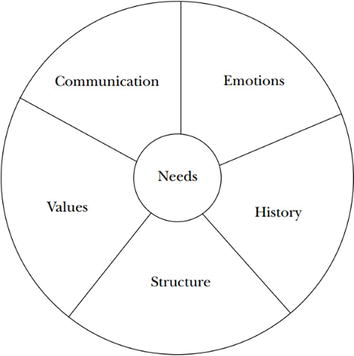
Wheel of conflict diagram by Bernard Mayer, PhD
Bernard Mayer (2000, p. 9) captured the concept of human needs in the Wheel of Conflict as shown in the above diagram. The more we focus on basic needs, the more we discover the commonality of cultures, the values we all share as humans. Conversely, the farther away from the basic needs, the more diametrically the differences among cultures. The conclusion we can draw from the Wheel of Conflictanalysis is that at the heart of all human conflict is the basic human needs.
Cultural differences do not, in themselves, result in conflict. What makes America the greatest nation on Earth is that the United States is a melting pot of world cultures. Take a casual walk in Manhattan and you may find that seven out of every ten people you meet come from completely different cultural backgrounds. Yet, the United States is the most stable, safe, and peaceful nation on Earth! What leads to conflict is the denial of basic human needs, or the failure to recognize and address the basic needs of the parties to a conflict.
We are sometimes so blinded by our own cultures that any action or behavior that doesn’t make sense to us from our cultural perspectives is either wrong or strange or offensive. Rather than try to impose our own cultural values on the disputants or pretend that culture is unimportant in cross-cultural settings, mediators should adjust their cultural lenses to understand the interests of the other parties.
Understanding cultural differences, and how to overcome the challenges they pose to mediation is the most important task of the mediator. Barkia (2008) suggested three approaches to effective cross-cultural mediation to include, pre-mediation, caucusing, and Socratic questioning. The pre-mediation session offers mediators the opportunity to prepare the disputants for mediation. The caucusing session enables mediators to evaluate the emotional state and cultural dispositions of the disputants and the Socratic questioning sessions allows mediators to move beyond the entrenched positions to the disputants’ overriding interests that are the drivers of the conflict. Although Barkia limits the application of these principles to international commercial disputes, they are certainly applicable to every other form of conflict across cultural boundaries.
Mediation has emerged since the past 50 years as an effective alternative method of conflict resolution in terms of cost, time, emotional and relational considerations. The growing acceptance of the mediation process in many industrial countries derives especially from the high rate of compliance with the terms of dispute settlement, and the opportunity it gives to the parties in conflict to determine the outcome of the process. The cultural context of conflict should be taken into account when designing an intervention strategy, bearing in mind that culture does not determine the outcome of a conflict. Cultural determinism and cultural relativism will amount to stereotyping which, in itself, may be obstructionist to an effective mediation process. Mediators working in cross-cultural settings may want to look beyond cultural differences and focus on the basic needs of the disputants as the main driver of conflict. The larger purpose of mediation is not to determine who is right or who is wrong in a conflict situation. Mediation is fundamentally future oriented and seeks above all to help the parties determine how they may continue to live and work together in a harmonious relationship in the future.
Mediators working in cross-cultural environments should be sensitive to cultural sensibilities of the parties in dispute. Indeed President Jimmy Carter offers a recipe for effective mediation in cross-cultural boundaries. He outlined the delicate and complex negotiations leading the signing of the Camp David Accord between Israel and Egypt in conversation with James Laue, Lynch Professor of Conflict Resolution at George Mason University on peacemaking which took place during the fifth National Conference on Peacemaking and Conflict Resolution in Charlotte, North Carolina on June 7, 1991. Perhaps the greatest lesson we can learn from the former president came in an interview about the secret of his successful mediation activities across cultural boundaries. He said that the most important technique for an international negotiator is to put himself in the other party’s shoes in order to understand the other party’s position and develop a different perspective (Negi, 2007).
References
Aquilon, M. (2006). Cultural Dimensions in Logistics Management. Quoted by John
Barkia in What’s a Cross-Cultural Mediation to do? A Low-context solution for a high-context problem. Cardozo Journal of Conflict Resolution, 10(1), 83.
Retrieved from http://cojcr.org/vol10no1/43--90.pdf/
Barkia, J. (2008). What’s Cross-Cultural Mediation to do? A Low-context solution for a high-context problem. Cardozo Journal of Conflict Resolution, 10(1), 4-90.
Retrieved from http://cojcr.org/vol10no1/43-43-90.pdf/
Doherty, D. and Guyler, M. (2008). The Essential Guide to Workplace Mediation and
Conflict Resolution. Philadelphia, PA: Kogan Page Limited.
Mayer, B. (2000). The dynamics of conflict resolution. San Francisco, CA: Jossey-
Bass.
Moore, C. (2003). The Mediation Process: Practical Strategies for Resolving Conflict.
San Francisco, CA: Jossey-Bass.
Negi, Vikrant, S. (2007, October 30). Cultural Challenges in Cross Border Mediation.
Law and Technology Resources for Legal Professionals (LLRX). In Jackson H.
Ralston Lecture: Principles of Negotiation, 23 Stan. J. Int'l L. 1, 2 (1987). Retrieved
from www.llrx.com/features/crossbordermediation.htm/
See Negi, V.S. (2007). In Cultural Challenges in Cross Border Mediation.
Law and Technology Resources for Legal Professionals (LLRX). In Jackson H.
Ralston Lecture: Principles of Negotiation, 23 Stan. J. Int'l L. 1, 2 (1987). Retrieved
from www.llrx.com/features/crossbordermediation.htm/
Slate, S. (2009). Training Manual. Institute for Mediation and Conflict Resolution. New York.
Ury, W. L. (October 1995). Conflict Resolution among the Bushmen: Lessons in
Dispute Systems Design. Negotiation Journal, 11 (4), 379-389. Retrieved from
http://www.colorado.edu.peace/example/ury7503.htm/
Wright, W. (January, 2000). Cultural Issues in Mediation: Individualist and Collectivist
Paradigms. Retrieved from http://www.mediate.com/articles/wrights.cfm/
Zartman, Z and Touval, S. (1996). International Mediation in the Post-Cold War Era.
Managing Global Chaos, eds. Chester Crocker, Fen Hampson and Pamela Aall.
Washington DC: United States Institute for Peace. Retrieved from